By MyLuso
Portugal entered a new political chapter on March 9, 2026, as António José Seguro formally assumed office as President of the Republic during a solemn ceremony held at the Assembly of the Republic in Lisbon. The event marked the official start of his five-year mandate as the country’s head of state, succeeding Marcelo Rebelo de Sousa, who completed the constitutional limit of two terms.
The inauguration followed Portugal’s presidential election earlier this year, in which Seguro secured a decisive victory in the runoff election held on February 8. In that vote, he defeated Chega party leader André Ventura by a wide margin, receiving roughly two-thirds of the vote—an electoral result that reflected strong nationwide support.
A Ceremony Steeped in Tradition
The inauguration ceremony followed the traditional constitutional protocol that accompanies the transfer of presidential authority in Portugal. The session opened in the morning at the parliament building in Lisbon, where lawmakers and dignitaries gathered to witness the formal swearing-in.
Upon entering the chamber, Seguro took the oath of office on the Portuguese Constitution, formally pledging to uphold the democratic institutions of the republic. After the oath, a ceremonial 21-gun salute was fired and the national anthem was performed, marking the symbolic transition of power.
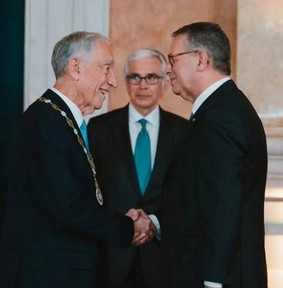
Once the official act of investiture was read and signed, parliamentary leaders delivered remarks, followed by Seguro’s first speech as president. In keeping with tradition, the new head of state then greeted his predecessor and other guests before leaving the chamber to participate in further official ceremonies.
International Presence at the Inauguration
The ceremony also drew the attention of international leaders and representatives, reflecting Portugal’s diplomatic ties across Europe and the Lusophone world. Among those attending were Spain’s King Felipe VI and several presidents from Portuguese-speaking nations, including Angola, Cape Verde, Mozambique, São Tomé and Príncipe, and Timor-Leste.
Their presence underscored Portugal’s longstanding relationships with countries connected through history, language, and cultural exchange.
A Day of Symbolic Gestures
Following the ceremony at parliament, Seguro continued the traditional presidential itinerary. One of the most symbolic moments came when he visited Lisbon’s Jerónimos Monastery to lay a wreath at the tomb of Luís de Camões, the poet widely regarded as a central figure in Portuguese national identity.
Later in the day, the new president arrived at Belém Palace, the official residence of the Portuguese head of state. There he hosted a formal luncheon for visiting dignitaries and foreign leaders. The palace gardens were subsequently opened to the public, allowing citizens to participate in the day’s celebrations.
A New Political Phase for Portugal
Seguro’s presidency begins at a moment when Portugal’s political landscape has experienced several electoral cycles in a relatively short period. In his remarks, he suggested that the country now has an opportunity to move toward stability and longer-term solutions, after months marked by multiple elections and political competition.
Although the Portuguese presidency is largely ceremonial compared to executive offices in some other systems, it remains a significant institution within the country’s constitutional framework. The president has the authority to appoint the prime minister, veto legislation, dissolve parliament under certain conditions, and serve as a moderating figure during periods of political tension.
Looking Ahead
With his inauguration complete, António José Seguro now begins his five-year term as the 21st President of Portugal. His presidency will be closely watched both domestically and internationally, particularly as the country navigates political stability, economic priorities, and its role within the European Union and the wider Lusophone world.
For many observers, the ceremony in Lisbon was more than a constitutional formality – it marked the beginning of a new phase in Portuguese political life.